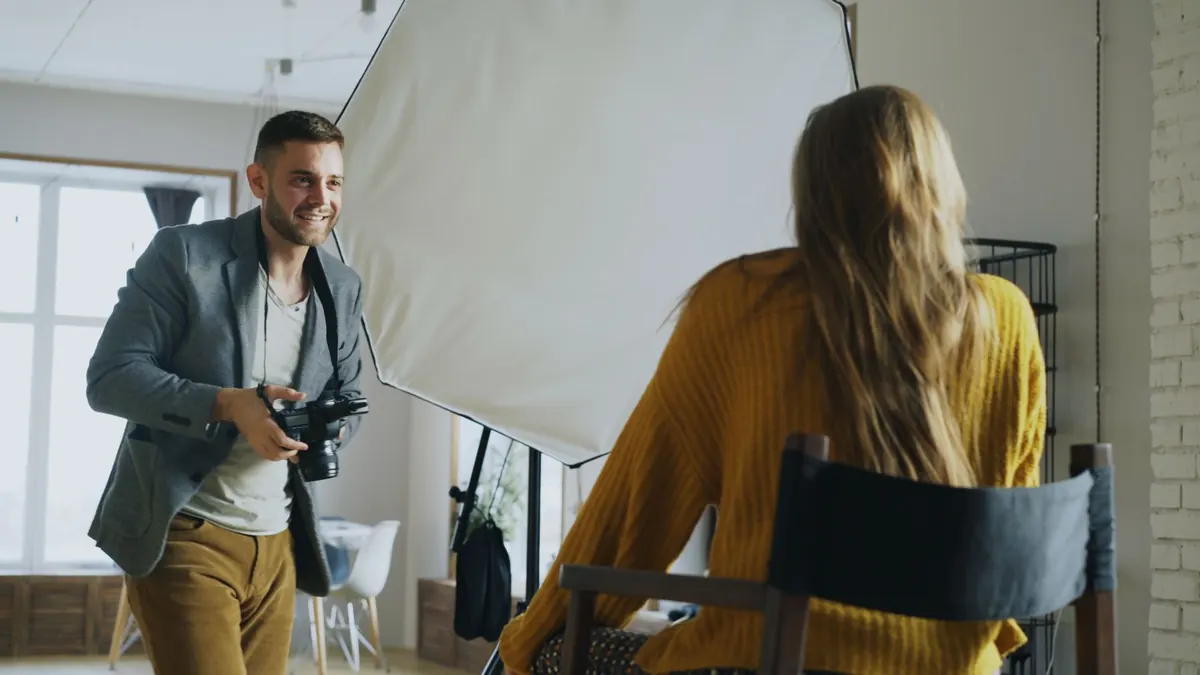
Nobody arrives at a portrait session hoping to look stiff. They arrive hoping to look like the version of themselves they see in the good mirror — and then they stand in front of a lens, forget what to do with their arms, and freeze. That freeze is not a personality flaw; it is a reasonable response to being watched. Your job is not to tell them to relax. It is to build a set of small, boring instructions that keep their body busy while their attention drifts somewhere more useful.
What follows is the checklist used across a full session, from the first message to the last frame. None of it requires expensive gear or a studio. It does require you to talk more in the first ten minutes than you might expect, and to keep shooting when the moment looks unremarkable.
Before the session: remove the unknowns
Most nerves are fear of the unknown, so spend your preparation on making the shoot predictable. A short message two days ahead that covers where to meet, how long it will take, what to wear and what happens first will do more for a nervous subject than any joke you tell on arrival.
Be specific about clothing. "Wear something you already feel good in, with sleeves you can push up, and avoid large logos" is usable. "Smart casual" is not. Ask them to bring two options and to arrive in the one they like most, so the decision is already made when they walk in.
Ask one question in advance: is there anything about being photographed that you already know you dislike? People will tell you the truth — "I hate my left side", "I always blink", "I look angry when I'm concentrating". Knowing it lets you address it in the first minute instead of discovering it in frame ninety.
The first five minutes, camera down
Leave the camera in the bag. Sit down, or stand in a relaxed way, and talk for a few minutes with nothing in your hands. Explain the plan for the session in plain terms: a few warm-up frames that will probably be bad, then some movement, then you will show them one or two images so they can see what you are seeing.
That last promise matters. A first-time subject has no idea what is on your screen, and imagination fills the gap with the worst possible picture. When you show a frame later, pick a good one. This is not dishonesty; it is calibration.
Then start with something easy and physical. Ask them to walk to a spot, turn around, shake out their hands, and take one long breath out. Five or six frames of them doing nothing in particular will loosen the shoulders more reliably than any instruction.
Give the hands a job
Hands are the first thing to go awkward. A nervous subject either hides them behind their back, holds them clamped at their waist, or flattens both palms against their thighs. Fix this with a specific job rather than a general instruction. "Put your hand on your hip" produces a claw; "hook your thumb into your pocket" produces a person.
Have a menu ready so you are never hunting for an answer in the moment:
- Thumb hooked in a pocket or belt loop, fingers relaxed and visible.
- Fingers loosely holding the edge of a sleeve, collar or jacket lapel.
- One hand on a hip bone, fingertips only, elbow soft rather than winged out.
- Both hands wrapped around something real — a mug, a bag strap, a folded jacket.
- Seated: elbows on knees, hands loosely clasped, leaning slightly forward.
- Arms lifted behind the head for a stretch, then dropped halfway and caught mid-motion.
Two rules cover most of it. First, avoid symmetry: when both hands do the same thing at the same height, the body reads as a diagram. Second, keep the wrists soft. A bent wrist breaks the line of the arm and instantly looks posed; a straight, locked wrist does not. If you can see tension in the fingers, ask them to shake the hand out for three seconds and then place it again, more lightly.
What to say while you shoot
Silence makes people perform, because they assume they are being judged. Talk — but not about the photographs. Ask questions that require a real answer and keep shooting while they reply. The moment of concentration before speech is usually better than the smile that follows it.
Specific questions work better than broad ones. "What did you do on your last day off?" gives you somewhere to go. "Tell me about your week" gives you a polite summary. If they are shy, offer a choice instead of an open question: "Coffee or tea person?" is answerable by anyone and buys you ten seconds of unguarded face.
A few phrases to retire, because they invite self-monitoring: "look natural", "relax", "act normal", "give me a real smile". The moment someone is asked to produce an authentic expression, they start checking whether they have managed it. Replace them with actions. Instead of "smile", try "think about the last thing that made you laugh in the last week and don't tell me what it was."
Also resist the urge to over-direct. Two instructions at once — chin down, shoulders back, weight on the left — and the subject will do none of them properly. Give one adjustment, let them settle, take three frames, then give the next.
Movement beats posing
Still bodies stiffen. If a subject has gone wooden, do not adjust their posture; give them something to do. Ask them to walk toward you and stop when they feel like it. Ask them to turn slowly on the spot and pause halfway. Ask them to sit down, then lean forward onto their elbows. Ask them to fix their collar, push their hair back, or check their phone and then look up.
Counted actions are especially useful for the very tense. "On three, breathe out and drop your shoulders — one, two, three." The count gives their attention a job, and the exhale does the physical work for you. The frame right after an exhale is consistently softer than the one before it.
Small resets worth keeping in your pocket
Ask for a full-body shake-out, like a swimmer before a race. Have them look away from the lens entirely, out of a window or across the room, while you keep shooting. Give them permission to close their eyes for two seconds. Change something in the environment — move to a different wall, open a door — because a new location resets the self-consciousness that built up in the old one.
Reading tension before it ruins a set
Watch for early signals rather than waiting for the obvious ones. Raised shoulders, a clenched jaw, hands that have drifted back to a clasp, a chin pushed up as a substitute for confidence, a smile that stays frozen for more frames than a real one would. Apologising is another tell: "Sorry, I'm so awkward" means they need a reset, not reassurance.
When you see two of these at once, stop shooting and change the situation rather than the instruction. Sit down together for a minute. Show them the good frame from earlier. Then restart with movement rather than a pose.
The last ten frames
By the end of the session most subjects have finally warmed up, which means the best frames often sit in the final stretch. Do not announce that you are nearly done; just keep going a little longer and let the conversation run. Then finish cleanly: tell them what happens next, when they will see the images, and that you will send a small preview so they are not waiting in the dark.
Send that preview within a day or two. A nervous first-timer who sees one good photograph of themselves quickly becomes a relaxed repeat client — and the next session starts from a far easier place.
Photo: Vitaly Gariev / Pexels